Sharing Templates Between Dashboards
Templates normally belong to the dashboard that defines them. If you keep several
dashboards — a main one, a tablet one, a phone one — you would otherwise have to paste the
same decluttering_templates block into each, and keep all the copies in step.
decluttering_templates_from lets one dashboard borrow another’s templates.
Setting it up
1. Put the templates on one dashboard
Pick (or create) a dashboard to hold the library. Its URL path is what you will refer to —
find it under Settings → Dashboards. Here it is dcp-shared.
# dashboard: dcp-shared
decluttering_templates:
  house_room:
    card:
      type: tile
      entity: '[[light]]'
      name: '[[room]]'
      icon: '[[icon]]'
      features:
        - type: toggle
    default:
      - icon: mdi:lightbulb

views:
  - title: Shared templates
    cards: []
A dashboard used only as a library can be hidden from the sidebar — the templates are still readable.
2. Borrow them
On the other dashboard, add decluttering_templates_from at the root, alongside
views::
# dashboard: dcp-borrow
decluttering_templates_from:
  - dcp-shared

views:
  - title: Borrowed
    cards:
      - type: custom:decluttering-card-plus
        template: house_room
        variables:
          - light: light.kitchen
          - room: Kitchen
          - icon: mdi:silverware-fork-knife
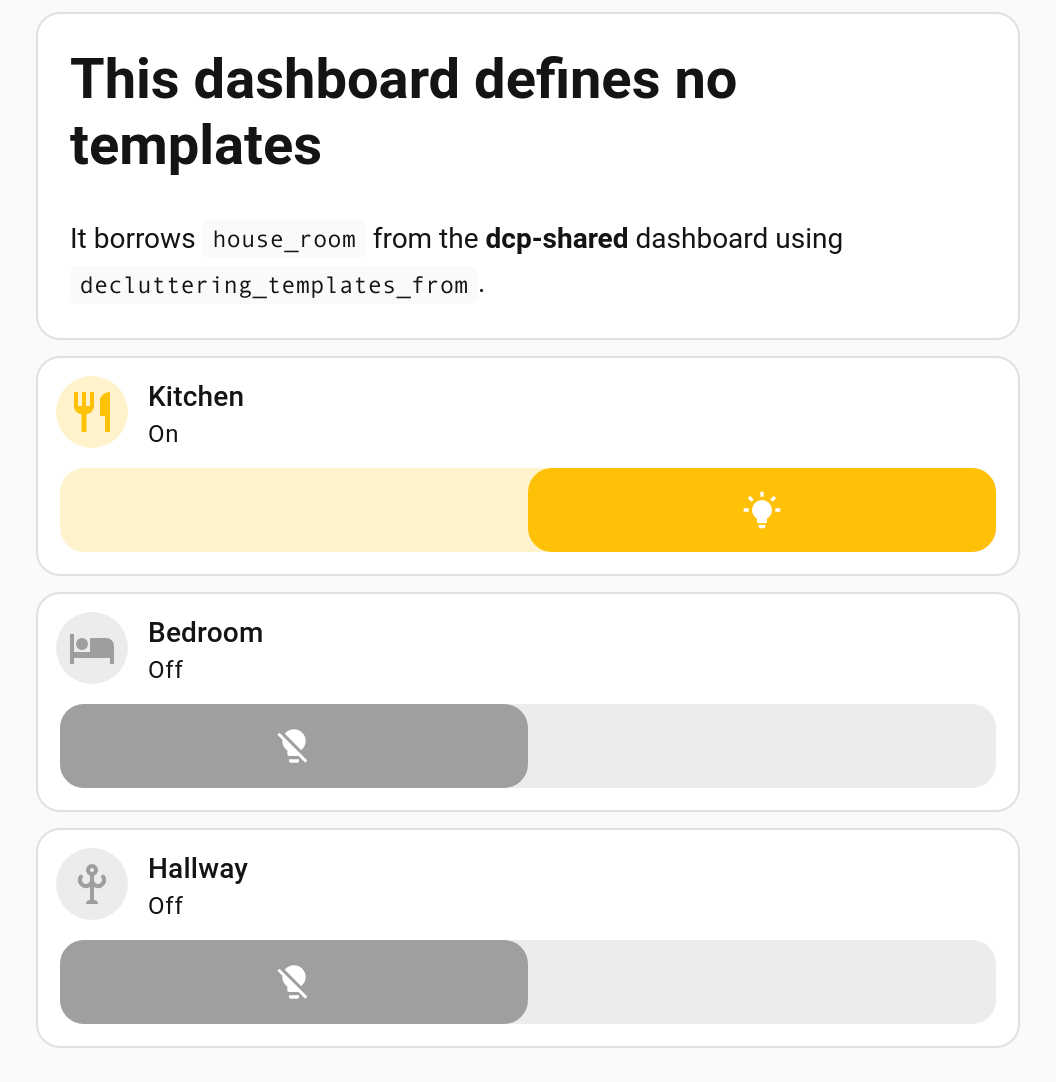
That dashboard defines no templates of its own, yet house_room works:
Borrowing from every dashboard: '*' (v1.8.0+)
decluttering_templates_from: '*'
'*' stands for every dashboard there is, so a library spread across several of them is
available everywhere without listing each one. Named sources can sit alongside it and keep
their place ahead of it — ['dcp-shared', '*'] — so their templates win a name clash, and
nothing is fetched twice.
Rules
Your own templates win. A dashboard’s own decluttering_templates (and its
decluttering-template-plus cards) take precedence over anything borrowed, so borrowing
can never silently change a template you already have. Use that to override one template
from the library while borrowing the rest.
Several sources are allowed, listed in order:
decluttering_templates_from:
  - shared-core
  - shared-experimental
Later sources override earlier ones; your own dashboard still beats all of them.
A single string works too, for the common one-source case:
decluttering_templates_from: shared-core
Borrowing is not recursive. If A borrows from B, and B borrows from C, then A
gets B’s own templates but not C’s. List C in A as well if you need it.
The default dashboard — the original one with no URL path of its own — can be named as
lovelace, default, or an empty string.
Shared default values (v1.1.0+)
A dashboard can set values its templates fall back on, so a colour or a size shared by a
library of them is written once instead of repeated in every template’s default: list:
decluttering_defaults:
  colour: amber
  icon_size: 32px
decluttering_templates:
  room_tile:
    card:
      type: tile
      entity: '[[entity]]'
      icon_color: '[[colour]]'
views: []
They sit at the bottom of the order, so nothing you already have changes: a value on the
card wins, then a declaration’s default, then the template’s default: list, and these
last.
In YAML mode a yaml anchor already does this. In storage mode there are no anchors, which is the whole reason for it.
A borrowed template gets both dashboards’ values, yours first. The lender’s are still underneath, so a template goes on working where it lives — and borrowing a library never means giving up what you set here.
A template card’s preview uses them too (v1.10.0+), so a template can leave a value to
the dashboard and still preview properly in edit mode. That makes this the place for a value
that should differ between dashboards sharing one template — a [[dashboard]] in a
navigation path, say: leave it out of the template, set it here on each dashboard, and each
one’s own value wins for the cards on it.
Defaults for one view (v1.8.0+)
A view can carry its own decluttering_defaults, for the cards on that view only:
decluttering_defaults:
  colour: amber            # the whole dashboard
views:
  - title: Bedroom
    decluttering_defaults:
      colour: slate        # just this view
    cards: []
They come straight after the card: a value on the card wins, then the view’s, then a
declaration’s default, then the template’s default: list, then the dashboard’s. So one
view can look different without touching a single card or template, even where the template
gives the same name a default of its own.
Changed in v1.9.0: in v1.8.0 a view’s values sat underneath the template’s defaults and only filled names the template left empty. The dashboard-wide ones have not moved.
Defaults for one section (v1.10.0+)

In a sections view, a section can carry its own decluttering_defaults too, so the same
templated cards can sit in several sections of one page with different values:
decluttering_defaults:
  colour: amber            # the whole dashboard
views:
  - title: House
    type: sections
    sections:
      - type: grid
        cards:
          - type: heading
            heading: Downstairs
          - type: custom:decluttering-card-plus
            template: lamp_tile
            variables:
              - entity: light.living_room
          - type: custom:decluttering-card-plus
            template: lamp_tile
            variables:
              - entity: light.kitchen
      - type: grid
        decluttering_defaults:
          colour: indigo       # just this section
        cards:
          - type: heading
            heading: Upstairs
          - type: custom:decluttering-card-plus
            template: lamp_tile
            variables:
              - entity: light.bedroom
          - type: custom:decluttering-card-plus
            template: lamp_tile
            variables:
              - entity: light.hallway
A section’s values beat its view’s, so the full order is: the card, the section, the
view, a declaration’s default, the template’s default: list, the dashboard. Cards inside
a stack or grid within the section count as in it.
To add them from the UI, edit the section and switch its editor to YAML. Editing the section’s other settings afterwards keeps them.
Caching and refreshes
Reading another dashboard is a round trip to Home Assistant, so the result is cached for the life of the page. One fetch per source dashboard, however many templated cards are on screen.
The consequence: after editing a template on the source dashboard, refresh the browser on the dashboards that borrow it. They will not pick the change up on their own. Editing a template on the dashboard that owns it behaves as normal.
Timing
A borrowed template has to be fetched, which cannot happen while the card is first being configured. Cards that use one therefore resolve a moment after the page loads. You may see them appear a beat behind the rest of the dashboard on a slow connection. Nothing is wrong.
The template dropdown in the card editor behaves the same way — it starts with the local templates and fills in the borrowed ones once they arrive, so it will not accuse you of a bad template name while it is still loading.
When it goes wrong
If the template cannot be found anywhere, the card shows:
The template “…” doesn’t exist in decluttering_templates, in a custom:decluttering-template card, or on any dashboard listed in decluttering_templates_from
If the source dashboard cannot be read at all — wrong URL path, or no permission — a warning goes to the browser console naming the dashboard:
decluttering-card-plus: could not read the dashboard "shared-core": …
Check the URL path against Settings → Dashboards. It is the path segment in the address bar, not the dashboard’s title.
→ Defining Templates · Troubleshooting
To hand a template to another person rather than another dashboard, see Sharing a Template.