Badges
Badges are the small pills across the top of a sections view. A badge template makes them
reusable in exactly the way card does for cards.
Badges need the sections view type, so Home Assistant 2024.8 or newer.
decluttering_templates:
  power_badge:
    badge:
      type: entity
      entity: '[[entity]]'
      name: '[[name]]'
      color: '[[color]]'
      show_name: true
    default:
      - color: blue
Use it in a view’s badges: list:
views:
  - type: sections
    badges:
      - type: custom:decluttering-card-plus
        template: power_badge
        variables:
          - entity: sensor.solar_power
          - name: Solar
          - color: yellow
      - type: custom:decluttering-card-plus
        template: power_badge
        variables:
          - entity: sensor.house_power
          - name: House
          - color: red
      - type: custom:decluttering-card-plus
        template: power_badge
        variables:
          - entity: sensor.living_room_temperature
          - name: Living Room
          - color: green
    sections:
      - type: grid
        cards: []
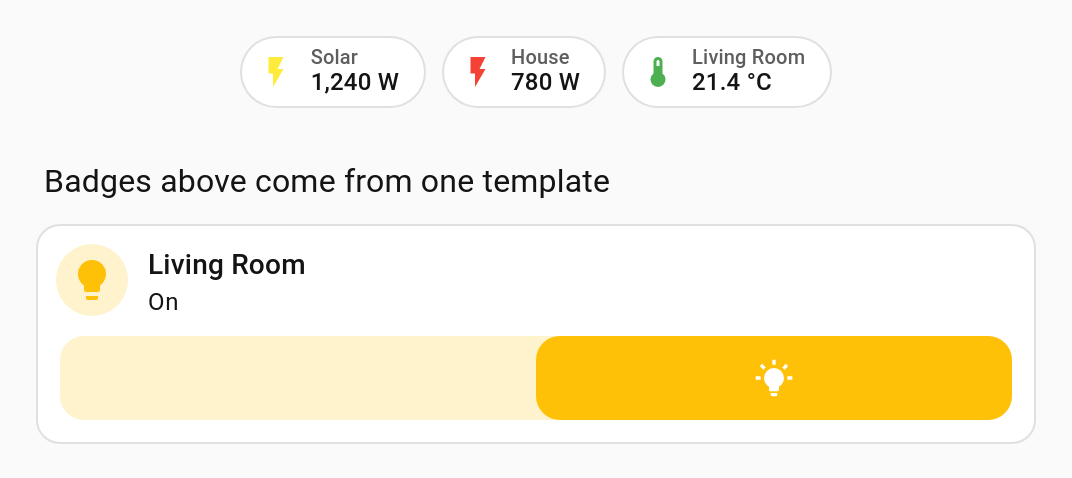
Three badges, one template, one variable each for the bit that differs.
Adding one through the UI
While editing a sections view, click + Add badge, then By card, and search for declutter. Pick Decluttering Card Plus — the same card serves badges and cards, and it works out which you meant from the template you choose.
How it sits in the layout
Badges live in a flex row, so the wrapper gets out of the way completely rather than boxing the badge — it does not add a box, spacing, or a layout level of its own. Your badge sits in the row exactly as a normal one would.
One consequence: style reaches the badge itself, but there is no wrapper to paint on, so
selectors aimed at the host have nothing to style. See Styling.
A badge per item (v1.11.0+)
A badge fills one slot, so a badge template cannot repeat by itself. A view can repeat it instead: one badge per person, per light, per anything Home Assistant knows about. See Repeating Sections and Badges.
views:
  - title: Home
    strategy:
      type: custom:decluttering-card-plus
      badges:
        - for_each_from: { domain: person }
          badge:
            type: custom:decluttering-card-plus
            template: person_badge
      sections: ...
The template gets each person’s entity and name without being passed them.
Any badge type
badge: takes any badge configuration Home Assistant supports, including custom badges
from other integrations:
decluttering_templates:
  person_badge:
    badge:
      type: entity
      entity: '[[person]]'
      show_state: true
      show_name: true
      tap_action:
        action: more-info
badges:
  - type: custom:decluttering-card-plus
    template: person_badge
    variables:
      - person: person.john
Reference
| Key | Where | Description |
|---|---|---|
badge: |
template | The badge configuration, with [[variables]] |
default: |
template | Fallback variable values |
template: |
instance | Name of the template |
variables: |
instance | Values to substitute |