Configuration Reference
Every option, in one place.
Dashboard root
Keys that go at the top level of a dashboard’s configuration, alongside views:.
| Key | Type | Description |
|---|---|---|
decluttering_templates |
mapping | Template definitions, keyed by name. See Defining Templates. |
decluttering_templates_from |
list of strings, or a single string | URL paths of dashboards to borrow templates from; '*' means every dashboard (v1.8.0+). See Sharing Templates Between Dashboards. |
decluttering_defaults (v1.1.0+) |
mapping, or a list | Values every template on this dashboard falls back on, reached last of all |
views[].decluttering_defaults (v1.8.0+) |
mapping, or a list | Values for the cards on one view. Beat the template’s own defaults (v1.9.0+); only a section’s values and a value on the card beat them |
views[].sections[].decluttering_defaults (v1.10.0+) |
mapping, or a list | Values for the cards in one section of a sections view. Beat the view’s; only a value on the card beats them |
decluttering_templates:
  room_light:
    card:
      type: tile
      entity: '[[light]]'

decluttering_templates_from:
  - shared-templates

decluttering_defaults:
  colour: amber

views: []
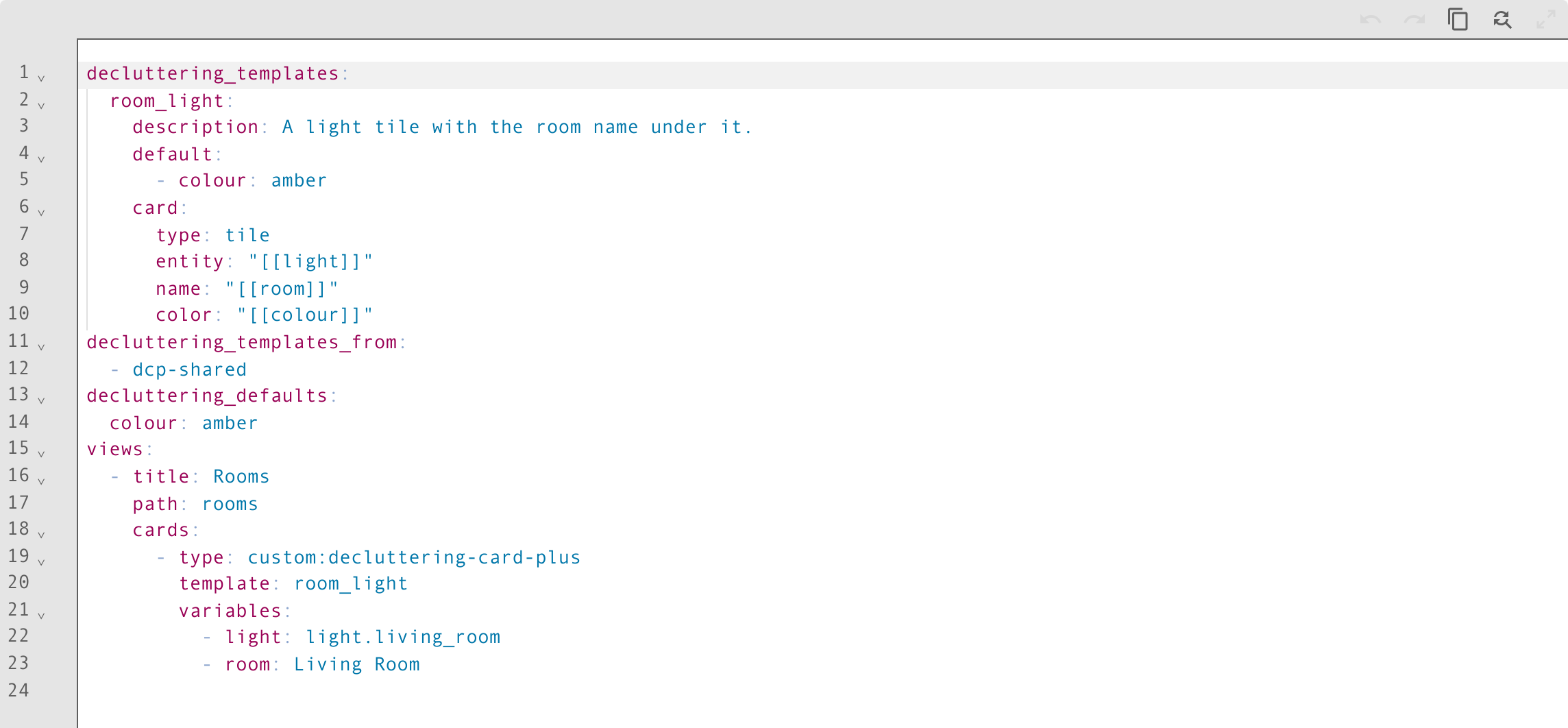
The same keys in the raw configuration editor, which is where a dashboard in storage mode is edited: ⋮ → Raw configuration editor.
Template definition
Whether written under decluttering_templates or as a decluttering-template-plus card.
| Key | Type | Required | Description |
|---|---|---|---|
card |
mapping | one of these four | A card |
badge |
mapping | one of these four | A badge |
row |
mapping | one of these four | An Entities card row |
element |
mapping | one of these four | A Picture Elements element |
description |
string | — | What the template is for. Shown to whoever uses it. |
variables |
list | — | Descriptions of the variables it takes. See Describing Variables. |
default |
list, or a mapping | — | Fallback variable values. See Variables. |
let (v1.7.0+) |
mapping, or a list | — | Values the template computes for itself from the others. A card cannot override one. |
extends (v1.8.0+) |
string | — | Another template this one starts from. See Defining Templates. |
category (v1.8.0+) |
string | — | Groups the template in the picker |
style |
string | — | CSS to inject. See Styling. |
Exactly one of card, badge, row, element. Any other combination is an error:
You must define one card, badge, element, or row in the template
custom:decluttering-template-plus
Defines a template as a card. Visible only in edit mode.
| Key | Type | Required | Description |
|---|---|---|---|
type |
string | ✅ | custom:decluttering-template-plus |
template |
string | ✅ | The template’s name |
card / badge / row / element |
mapping | ✅ (one) | The content |
description |
string | — | What the template is for |
variables |
list | — | Variable declarations |
default |
list, or a mapping | — | Fallback variable values |
let (v1.7.0+) |
mapping, or a list | — | Values the template computes for itself |
extends (v1.8.0+) |
string | — | Another template this one starts from |
category (v1.8.0+) |
string | — | Groups the template in the picker |
style |
string | — | CSS to inject |
type: custom:decluttering-template-plus
template: room_light
card:
  type: tile
  entity: '[[light]]'
  name: '[[room]]'
default:
  - light: light.living_room
  - room: Living Room
custom:decluttering-card-plus
Uses a template.
| Key | Type | Required | Description |
|---|---|---|---|
type |
string | ✅ | custom:decluttering-card-plus |
template |
string | ✅ | Name of the template to use |
variables |
list, or a mapping | — | Values to substitute |
for_each |
list | — | Render the template once per item. Card templates only. See Repeating a Template. |
for_each_from (v1.1.0+) |
mapping | — | What to repeat over, read from Home Assistant rather than written out |
columns |
number | — | How many copies sit side by side. Defaults to 1 |
min_column_width (v1.1.0+) |
number | — | Pixels. Drops a column rather than going narrower |
gap (v1.2.0+) |
number | — | Pixels between repeated copies. Leave out for Home Assistant’s own spacing |
empty (v1.2.0+) |
card | — | What to render when a repeat produces no copies |
grid_options (v1.2.0+) |
mapping | — | How much of a sections grid to ask for. Beats the template’s |
debug (v1.2.0+) |
boolean | — | Render what the card builds instead of the card. See Troubleshooting |
strict (v1.2.0+) |
boolean | — | Refuse rather than render a variable nothing set |
fit (v1.1.0+) |
string | — | box (default) keeps a box of its own; contents gives it up. See Styling |
style |
string | — | Extra CSS, appended after the template’s |
style |
mapping | — | In a Picture Elements card only, this is the element’s position. See Elements. |
visibility |
list | — | Standard Home Assistant conditions, applied to this card |
type: custom:decluttering-card-plus
template: room_light
variables:
  - light: light.kitchen
  - room: Kitchen
Inside for_each_from (v1.1.0+)
| Key | Type | Description |
|---|---|---|
entities |
string, list or true |
Repeat over entities matching these id patterns. The default when areas is absent |
areas |
string, list or true |
Repeat over areas matching these patterns |
range (v1.2.0+) |
number | Repeat this many times, with only the position to go on |
devices (v1.8.0+) |
string, list or true |
Repeat over devices, by id or name pattern |
floors (v1.8.0+) |
string, list or true |
Repeat over floors, by id or name pattern |
labels (v1.8.0+) |
string, list or true |
Repeat over labels, by id or name pattern |
group_by (v1.8.0+) |
string | Fold an entity repeat into one copy per domain, area, floor or label |
domain |
string or list | Narrows to entities of these domains |
device_class (v1.2.0+) |
string or list | Narrows to entities reporting these device classes |
integration (v1.2.0+) |
string or list | Narrows to entities from these integrations |
area |
string or list | Narrows to these areas, by name or id |
floor |
string or list | Narrows to these floors, by name or id |
label |
string or list | Narrows to things carrying these labels, by name or id |
exclude (v1.2.0+) |
string, list or mapping | What to leave out. Patterns mean entity ids; a mapping narrows by anything above |
sort (v1.2.0+) |
string or list | name, entity, id, area, domain, floor. none keeps the registry order; any other name is read as a key the copies carry (v1.3.0+), and attr:<name> reads a state attribute (v1.5.0+). A leading minus reverses one key, and a list breaks ties with the next (v1.5.0+) |
reverse (v1.2.0+) |
boolean | Turns whichever order was chosen around |
limit (v1.2.0+) |
number | At most this many copies. total still reports what matched |
offset (v1.5.0+) |
number | Skip this many copies first, so two cards can split one list. total ignores the window |
require (v1.5.0+) |
string or list | Drop a copy whose named keys came out empty, before anything is counted |
overrides (v1.5.0+) |
mapping | Extra variables for particular copies, keyed by entity id, area id or pattern |
with (v1.2.0+) |
mapping | For an area source - or a device, floor or label one (v1.8.0+) - the entities to gather for each copy, plus keep_empty |
What every copy is given
| Name | From | Is |
|---|---|---|
index, count |
any repeat | Position counted from one, and how many |
index0, first, last (v1.2.0+) |
any repeat | Position from zero, and whether this is an end |
entity, name, domain, area, area_id |
an entity source | The entity and where it lives |
area_id, area, area_icon, floor |
an area source | The area and its floor |
device_id, device, name, area, area_id, manufacturer, model (v1.8.0+) |
a device source | The device and where it is |
floor_id, floor, name, level (v1.8.0+) |
a floor source | The floor |
label_id, label, name (v1.8.0+) |
a label source | The label |
group, name, items, entities, entity_count (v1.8.0+) |
group_by |
The group and what fell into it |
total (v1.2.0+) |
a registry source | What matched before limit and offset, and after require (v1.5.0+) |
items, entities, entity_count (v1.2.0+) |
an area source with with |
What is in that area |
Variable declaration
One entry of a template’s variables: list.
| Key | Type | Required | Description |
|---|---|---|---|
name |
string | ✅ | The variable’s name, as written in [[name]] |
label |
string | — | What the editor calls it. Defaults to the name |
description |
string | — | Helper text under the control |
selector |
mapping | — | Any Home Assistant selector. Defaults to a text box |
default |
any | — | The value to use when a card does not set one |
pattern (v1.8.0+) |
string | — | A regular expression the value should match. Warns, never blocks |
allowed (v1.8.0+) |
list | — | The values it may take. Warns, never blocks; wins over pattern |
group (v1.8.0+) |
string | — | Folds the declaration into a section of the card editor |
Variable syntax
| Form | Behaviour |
|---|---|
'[[name]]' as an entire value |
Substituted with the value, type preserved (number, boolean, mapping, list, null) |
[[name]] inside a longer string |
Substituted as text |
[[name|slug]] |
Lower case, non-alphanumeric runs become _ |
[[name|upper]] / [[name|lower]] |
Case changed |
[[name|title]] |
Each word capitalised |
[[name|kebab]] (v1.1.0+) |
Lower case, non-alphanumeric runs become - |
[[name|trim]] (v1.3.0+) |
Whitespace removed from both ends |
[[name|capitalize]] (v1.3.0+) |
First character upper-cased, the rest left alone |
[[name|replace:from:to]] (v1.4.0+) |
Every from swapped for to; no to deletes |
[[name|prefix:text]] / [[name|suffix:text]] (v1.4.0+) |
Text put in front or after; an empty value stays empty |
[[name|max:12]] (v1.4.0+) |
Shortened to that many characters, ending with … |
[[name|map:a=1,b=2]] (v1.4.0+) |
Looked up in the pairs; *= catches the rest |
[[name|json]] (v1.2.0+) |
The value as its JSON text. The one step that takes a mapping or a list |
[[name|friendly_name]] etc (v1.1.0+) |
Asks Home Assistant. Also area, device, attr:<name> |
[[name|floor]], [[name\|area_id]], [[name\|device_id]] (v1.2.0+) |
The floor, and the ids behind the names |
[[name|default:Text]] (v1.2.0+) |
That text when nothing set the variable |
[[name|or:other]] (v1.2.0+) |
Another variable’s value when nothing set this one |
[[name?]] (v1.1.0+) |
The key is removed entirely when nothing set it |
[[!name]] (v1.1.0+) |
The literal text [[name]] |
[[a.b]] (v1.2.0+) |
Reaches into a nested mapping, three levels deep |
| Any other word after the bar | Not a transform; left in place |
| No matching variable or default | Left in place as literal [[name]] |
Steps chain, left to right: [[room|or:name|default:Somewhere|slug|upper]]. A resolver
reads its value as an entity id, so it has to come before anything reshapes it.
A transformed placeholder is always text, whatever the value’s own type.
| Precedence | Winner |
|---|---|
variables on the card vs any default |
variables |
default inside a declaration vs the default: list |
the declaration |
| Same key listed twice | the first |
Substitution repeats until nothing changes, to a maximum of 10 passes. A self-referencing variable stops there with a console warning. A template that uses itself is refused outright (v1.2.0+) — see Troubleshooting.
Full detail: Variables.
Host classes
Applied to the wrapper element, for use in style.
| Class | Applied to |
|---|---|
decluttering-container |
Card, row and element templates |
decluttering-badge |
Badge templates |
decluttering-card |
Card templates only |
decluttering-fit-contents (v1.1.0+) |
A card set to fit: contents |
child-card-hidden |
A card hidden by its own visibility conditions |
The view strategy (v1.11.0+)
On a view, strategy: with type: custom:decluttering-card-plus. See
Repeating Sections and Badges.
| Key | Type | Description |
|---|---|---|
type |
string | custom:decluttering-card-plus |
sections |
list | Sections as written, and repeats that write one section per item |
badges |
list | Badges as written, and repeats that write one badge per item |
variables |
list, or a mapping | Values every repeated entry gets, underneath its own |
decluttering_defaults |
mapping | View-level values for the templated cards in the view |
| anything else | Passed to the view: max_columns, dense_section_placement, background… |
A repeated entry:
| Key | Type | Description |
|---|---|---|
for_each |
list | One copy per item |
for_each_from |
mapping | One copy per thing Home Assistant knows about. Same keys as below |
section / badge |
mapping | What each copy is, with placeholders filled from the copy |
variables |
list, or a mapping | Values every copy of this entry gets |
empty |
mapping | The section or badge to show when nothing matches |
Registered card types
| Type | Purpose |
|---|---|
custom:decluttering-card-plus |
Use a template |
custom:decluttering-template-plus |
Define a template |
custom:decluttering-card |
Compatibility alias, when the original card is not installed |
custom:decluttering-template |
Compatibility alias, when the original card is not installed |
The same resource also registers the view strategy custom:decluttering-card-plus (v1.11.0+).
See Migrating from decluttering-card.
Error messages
| Message | Meaning |
|---|---|
Missing template object in your config |
No template: on the card |
Missing template property |
No template: on the template card |
You must define one card, badge, element, or row in the template |
Zero, or more than one, content key |
for_each needs a template that defines a card |
for_each used with a row, badge or element template |
The template "…" doesn't exist in decluttering_templates or in a custom:decluttering-template card |
Name not found, and no borrowing configured |
The template "…" doesn't exist in decluttering_templates, in a custom:decluttering-template card, or on any dashboard listed in decluttering_templates_from |
Name not found anywhere, including borrowed dashboards |
Could not retrieve the lovelace configuration. |
The card could not find the dashboard config — see Troubleshooting |
Could not resolve the template "…": … |
A borrowed dashboard could not be read |
Console warnings:
| Warning | Meaning |
|---|---|
gave up substituting variables after 10 passes |
A variable refers to itself |
could not read the dashboard "…" |
A dashboard in decluttering_templates_from is missing or unreadable |
<…> is already registered by something else, skipping it |
Another card owns that type — usually the original decluttering-card |