Virtual Pets
Every child can look after a virtual pet that grows up as they do their chores. It starts as an egg, hatches into a baby and grows bigger with every job they finish. Once it is fully grown there is still more to work towards: a home to fill, a legendary golden coat, an egg that hatches into the next pet, and pet levels. It's a gentler motivator than a streak for younger children, because nothing is ever lost: a sleepy pet perks up again with the next chore.
New in v7.0.0
Turning Pets On
Pets are off until you switch them on:
TaskMate panel → Settings → Virtual pets → Turn on virtual pets
The same section holds every growth number described below. While pets are off, the Pet card says so and nothing about a pet is shown or counted.
Adopting a Pet
The child adopts their pet on the Pet card: they pick one of six creatures (dragon, cat, dog, bunny, dino or unicorn), give it a name and tap Adopt!
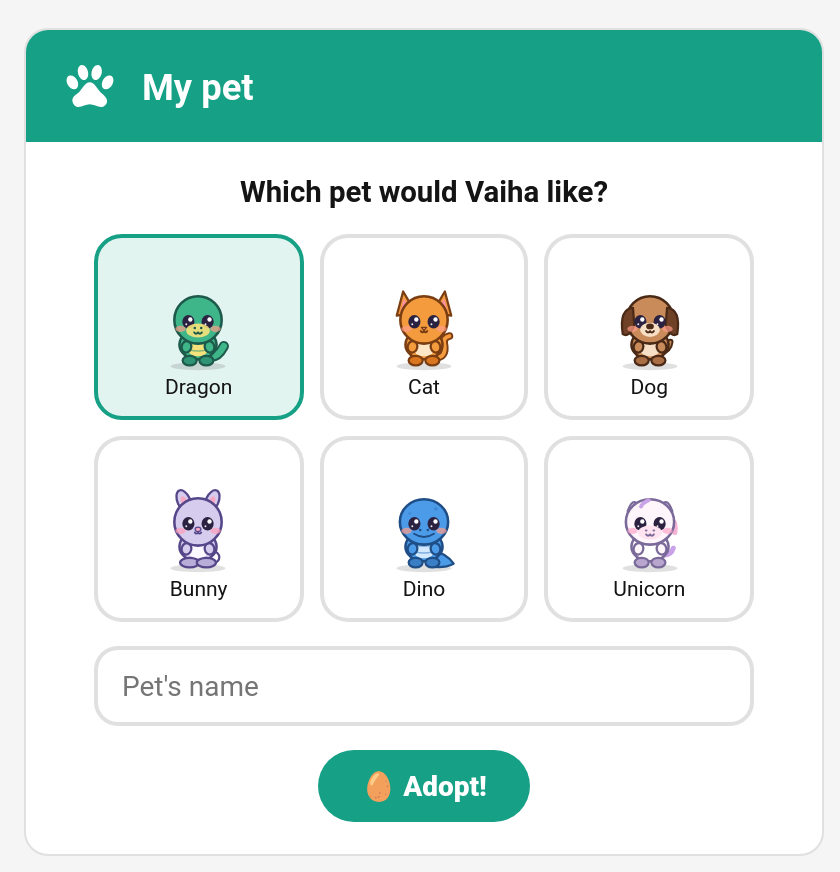
The pet starts as an egg and only counts chores finished from adoption onwards, so a child who has been using TaskMate for a year doesn't get a fully grown pet on day one.
Adopting again (the adopt_pet service with a new species or name) renames or re-chooses the pet but keeps its growth: it's still the same friend.
How It Grows
Every finished chore adds growth. By default:
- each chore is worth 10 growth, and
- every point the child earns adds 1 growth, so a big job grows the pet faster than a quick one.
Spending points never shrinks the pet: growth counts points earned, not the balance.
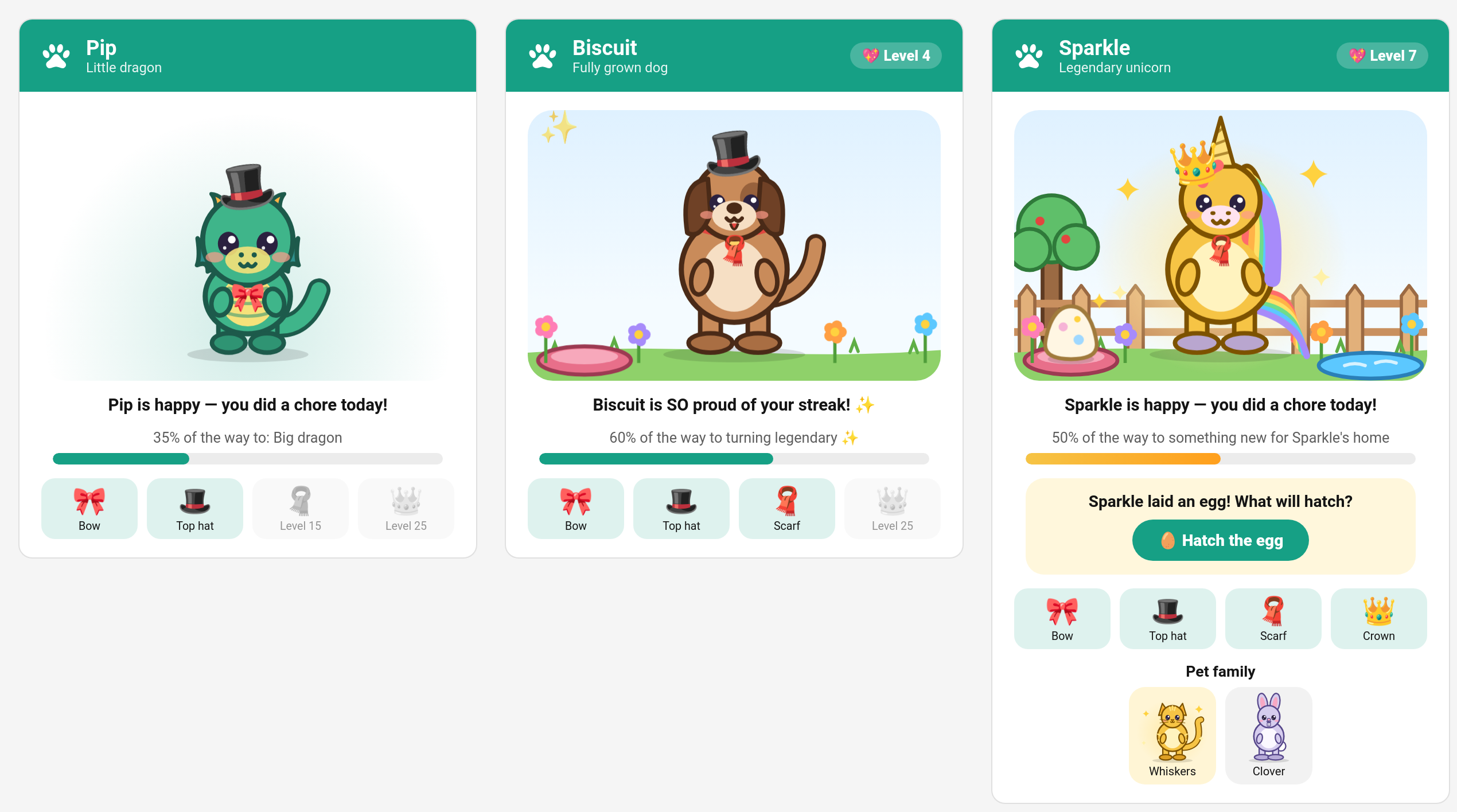
The pet moves through five stages, each drawn as its own picture:

| Stage | Card shows | Default growth | Roughly (5-point chores) |
|---|---|---|---|
| Egg | "A dragon egg" | 0 | at adoption |
| Baby | "Baby dragon" | 30 | 2 chores |
| Little | "Little dragon" | 200 | 13 chores |
| Big | "Big dragon" | 600 | 40 chores |
| Fully grown | "Fully grown dragon" | 1500 | 100 chores |
Babies are all head and eyes. As the pet grows it gets a body, legs and finally its grown-up features: wings and horns for the dragon, a mane for the unicorn, a collar for the dog, and so on.
A progress bar under the pet shows how far it is to the next thing ("35% of the way to: Big dragon").
It never goes backwards
A stage, a legendary coat, a home item or a pet level, once reached, is kept. Undoing a chore or raising one of the numbers in Settings leaves the pet where it got to; it just takes longer to reach the next step.
Moods
The pet's mood follows the child's last chore:
| Mood | When | What the card says |
|---|---|---|
| Happy | A chore was done today | "Pip is happy — you did a chore today!" |
| Proud | A chore today and a streak of 7 days or more | "Pip is SO proud of your streak! ✨" |
| Content | The last chore was yesterday | "Pip is resting. A chore today will cheer them up." |
| Sleepy | Longer than that | "Pip is sleepy… do a chore to wake them up!" |
Days away don't make a pet sleepy: on a vacation or a sick day the pet stays content, because the child was meant to rest.
Tapping the pet gives it a cuddle: a little hop and some hearts. Nothing is saved.
Accessories
Accessories are unlocked by the child's level, not the pet's growth:
| Accessory | Unlocks at |
|---|---|
| 🎀 Bow | Level 3 |
| 🎩 Top hat | Level 8 |
| 🧣 Scarf | Level 15 |
| 👑 Crown | Level 25 |
The pet wears every accessory the child has unlocked. Locked ones show greyed out on the card with the level they need.
After Fully Grown
Once the pet is fully grown, four things can keep it going. Each one can be switched on or off and tuned under Settings → Virtual pets → After fully grown. The numbers are total growth since adoption, so they always come after the "Fully grown" number. Turning one off only hides it; nothing earned is lost.
| Extra | Default | What happens |
|---|---|---|
| Its home grows | on, a new item every 300 growth | The pet's home fills up: grass, a cushion, flowers, a tree, a pond and more, up to 10 items |
| Turns legendary | on, at 3000 growth | The pet turns gold and sparkles. The big goal after fully grown |
| Lays an egg | on | The pet lays an egg the child can hatch into a new pet. With legendary on, the egg comes with legendary; with legendary off it comes at the Egg at number (3000 by default) |
| Pet levels | off, a new level every 300 growth | A level badge on the card that keeps going up |
Eggs and the pet family
When the pet lays an egg, the card shows Hatch the egg. The child picks a creature and a name, and the new pet starts again from an egg. The previous pet joins the Pet family row at the bottom of the card, legendary ones still in gold.
Largest pet family (6 by default, 2–12) caps how many pets a child can have, counting the current one. Once the family is full, no more eggs are laid.
Parent Settings
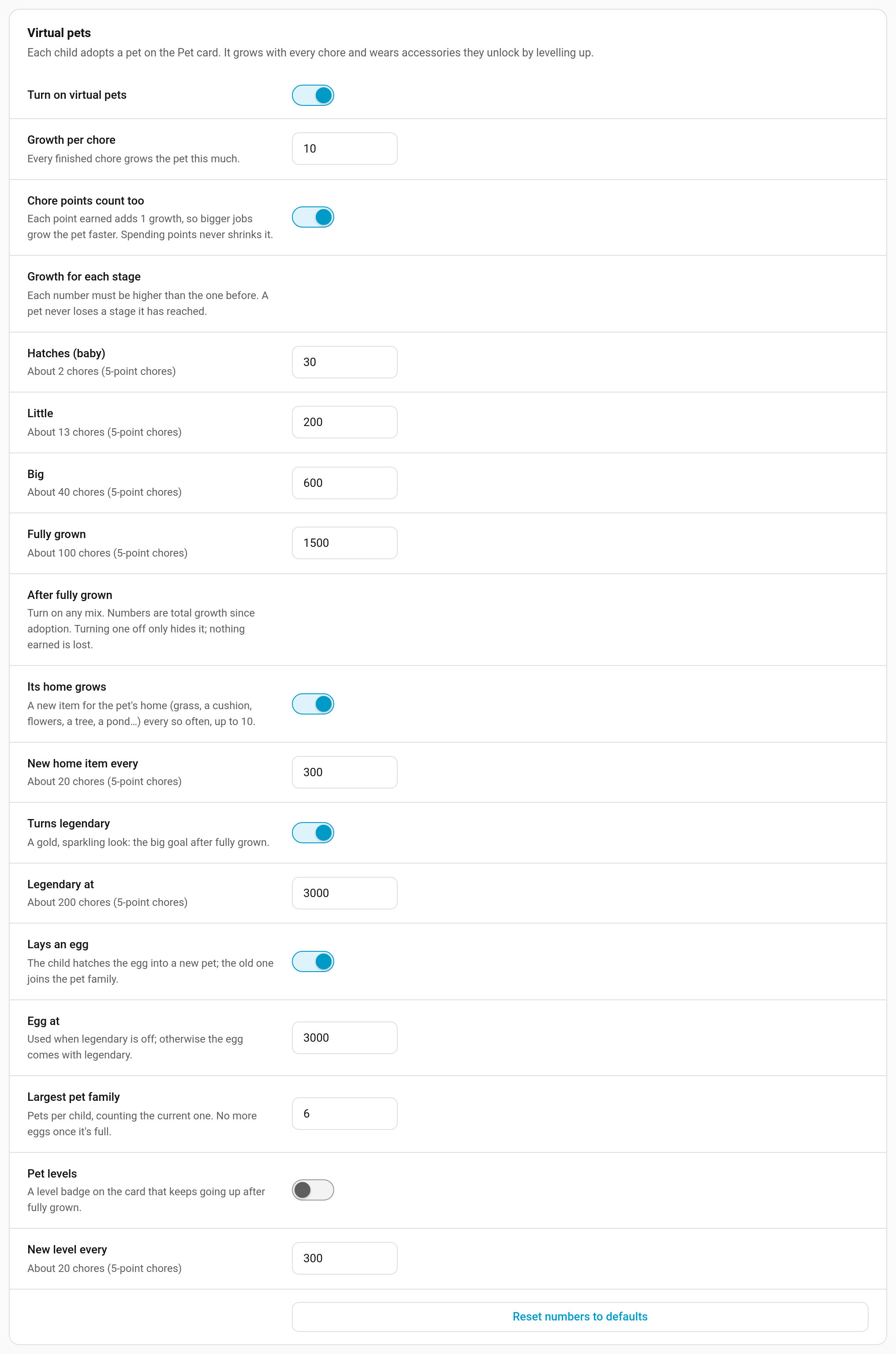
| Setting | Key | Default | Description |
|---|---|---|---|
| Turn on virtual pets | pets_enabled |
off | Master switch |
| Growth per chore | pet_xp_per_chore |
10 |
Growth for every finished chore (0–1000) |
| Chore points count too | pet_points_count |
on | Each point earned adds 1 growth |
| Hatches (baby) | pet_stage_baby |
30 |
Growth to hatch |
| Little | pet_stage_kid |
200 |
|
| Big | pet_stage_teen |
600 |
|
| Fully grown | pet_stage_grown |
1500 |
|
| Its home grows | pet_home_enabled |
on | |
| New home item every | pet_home_every |
300 |
|
| Turns legendary | pet_legendary_enabled |
on | |
| Legendary at | pet_legendary_at |
3000 |
|
| Lays an egg | pet_eggs_enabled |
on | |
| Egg at | pet_egg_at |
3000 |
Used only when legendary is off |
| Largest pet family | pet_family_max |
6 |
2–12, counting the current pet |
| Pet levels | pet_levels_enabled |
off | |
| New level every | pet_level_every |
300 |
Each stage number must be higher than the one before, and legendary and the egg must come after fully grown; the panel won't save numbers that break the order. Beside each number the panel shows roughly how many 5-point chores it takes. Reset numbers to defaults puts them all back.
If growth per chore is 0 and points don't count, pets can't grow, and the panel warns you.
The Pet Card
Edit dashboard → + Add Card → TaskMate Pet
type: custom:taskmate-pet-card
entity: sensor.taskmate_overview
child_id: 8e16ad66b23f404e
| Option | Type | Default | Description |
|---|---|---|---|
entity |
string | required | The TaskMate overview sensor |
child_id |
string | required | Whose pet this is. Find IDs in the panel with Show IDs switched on |
title |
string | the pet's name | Card title. Before adoption it reads "My pet" |
card_design |
string | global default | classic, playroom, console, cleanpro, accessible or graphite |
header_color |
string | #16a085 |
Header banner colour (YAML only) |
Before adoption the card is the adoption form. After that it shows the pet in its current stage and mood, the progress bar to the next goal, the accessories, the Hatch the egg box when an egg is ready, and the pet family.
The first time a device sees the pet reach something new (a stage, legendary, an egg, a home item or a level) the card plays a short "evolving" moment, once per device.
Notification and Event
The Pet grew up notification (off by default; switch it on under Notifications) tells the child and/or parents when a pet:
- reaches its next stage: "🐣 Pip just grew up! Have a look at Vaiha's pet."
- turns legendary: "✨ Sparkle turned legendary! Vaiha's pet is shining gold."
- lays an egg: "🥚 Sparkle laid an egg! Vaiha can hatch a new pet."
- reaches a new pet level: "💖 Sparkle reached pet level 4!"
Every one of these fires the taskmate_pet_evolved event whether or not the notification is on. Its data includes child_id, child_name, pet_name, species, kind (stage, legendary, egg or level), plus stage or pet_level where relevant. It also shows up as Pet grew up on the child's event entity.
Growth is checked once a minute, so a pet grows up within a minute of the chore that did it.
Services
| Service | Fields | Description |
|---|---|---|
taskmate.adopt_pet |
child_id, species (dragon, cat, dog, bunny, dino, unicorn), name (up to 24 characters), hatch_egg (optional) |
Adopt a pet, or rename/re-choose the current one (growth is kept). With hatch_egg: true, hatch the egg the grown pet laid; the old pet joins the pet family |
While pets are on, each child's entry in sensor.taskmate_overview's children attribute carries a pet object (stage, mood, growth, accessories, the next goal, and anything reached after fully grown).
Related
- Levels and XP — the child levels that unlock accessories
- Dashboard Cards — every TaskMate card
- Notifications — switching on the Pet grew up notification
- Weekly Goals — another motivator for the week
- Event Entities — automating on a pet growing up